by Don Southerton
In The Artist’s Way, Julia Cameron recommends writing “morning pages,” handwritten pages where thoughts surface in a stream of consciousness as the brain moves from sleep to wakefulness. You end up with some fascinating ideas on paper. That habit is what led to this essay, a look back at the story behind twenty-five years as a writer.
Two memories surface. One is from fifty-five years ago, in freshman English class and a creative essay that earned a poor grade, after which I found other passions and walked away from writing.
The other is from nearly twenty years later, in the middle of a life-changing crisis, when I returned briefly to writing and then just as quickly returned to my work routine.
Neither time did the habit stick. The third time did.
Finding My Voice at Forty-Seven
I returned to college at forty-seven, in the middle of a career change, to finish a bachelor’s degree after a twenty-seven-year break. Money was so tight that first semester back in college that I budgeted nine dollars a week for food: homemade pancakes for breakfast, microwaved frozen burritos for lunch, and inexpensive campus coffee to keep me going.
I enrolled in Managerial Accounting, Psychology, and Microeconomics, along with an American History elective. The accounting class required a final paper analyzing an IPO of a publicly traded company, and I chose one I had worked for, Master Glazier Karate.
My professor was intrigued and supportive, patient with a returning student for whom writing was still a weak point. She asked me to fix my font size, since my draft was in 10-point and I did not yet know how to change it. There was no Grammarly, and my typing was slow, my hands conditioned by years of traditional martial arts knuckle work. I worked at it, and got an A.
A summer English course further stretched my writing, and by fall I had settled on history as a major, with a weekly rhythm of class writing assignments and book reviews. Then came an opportunity I had not expected. One of my history mentors, James “Jay” Fell Jr., had been approached by a local family to compile a family history, and he passed the project to me. It gave me an academic identity I badly needed.
After a review of the manuscript, Jay reminded me that I needed to rely less on other people’s opinions: “Don, you are the historian.” I also had department-wide mentoring, including the late Mark S. Foster, the department’s most prolific writer, all the while spending weekends at the Denver Public Library’s Family History Archive chasing down Connecticut’s early settlers.
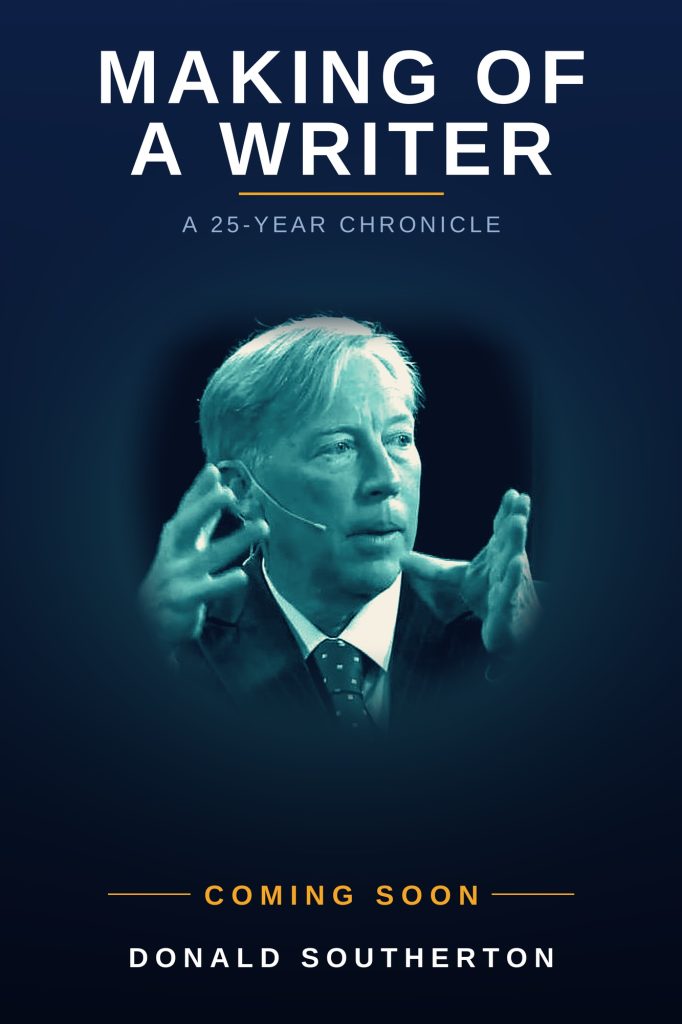
Early mornings on campus that second year started with a campus breakfast burrito and coffee before classes. Writing, when I had spare moments, was consuming, and it was therapy, and I wanted more of both. That is where “Making of a Writer” begins.
The Archives
As a historian, Mark Foster encouraged me to dig into local archives for topics that interested me. The first was James R. Walker, whose papers sat in the Colorado Historical Society’s Dr. James R. Walker Collection. Walker had worked on the Pine Ridge Indian Reservation, not far from where my mother’s family had homesteaded, land I had visited as a teenager and where I had seen the reservation’s hard conditions firsthand.
After research, writing, and several rounds of peer and editorial review, the piece was published by the South Dakota State Historical Society in 2004, my first published work. In 2008, I was invited back as one of thirteen contributing authors to a collection on twentieth-century Sioux political and cultural life.
No sooner had I finished with Walker than I found the Henry Collbran Archives at the same historical society. Collbran, a British-born entrepreneur who made his fortune in Colorado railroads, left for Korea in 1896 and went on to build the country’s first railroad, its early streetcar and power systems, its first telephone network, mines, and more, before Japan’s protectorate forced him to sell out. That research became part of my second book in 2005, and later its own biography.
It also marked the pivot point: Colorado’s overlooked ties to Korea, and a story of Americans as opportunity-seekers abroad, became a thread I would follow for the rest of my career.
From Historian to Business
After finishing my Colorado studies, I moved to Los Angeles to pursue Korean studies at USC.
While taking a joint class at UCLA, my professor, a respected Korean scholar, pushed back on my plan to stay in academia. Given my business and teaching background, he said, Korean companies would value someone who could bridge the culture. I sent a short mailing to Korean companies around Southern California offering a program, not yet named, on Korean history and culture. Hyundai Motor America called first in the summer of 2003.
Their HR team wanted six lunchtime sessions for Western employees. When they asked what to call the program, the name that stuck was “Korea 101.” My company name came from the work we did: Bridging Culture. Worldwide would come later, once we went international. In the meantime, a waiting list for Korea 101 formed immediately.
That period also produced Intrepid Americans: Bold Koreans, built on the Collbran research and the idea that early American traders and Korean officials, working through mining, rail, and port concessions, had shaped the roots of modern Korean business culture: trust, adaptability, and cross-cultural ties that still show up in the work today.
Songdo and the Hyundai Way
Two threads have run through nearly everything I have written since. One is Songdo, the city built on reclaimed land on Incheon’s coast, where I have advised the original developer and later chronicled the district’s transformation from an idea into a functioning Free Economic Zone.
The other is the Hyundai Motor Group, where close to twenty years of study produced Hyundai and Kia Motors: The Early Years, then Hyundai Way: Hyundai Speed across three editions. Broader Korea books include: Korea Facing, Korea Perspective, Korea 2020, and Korea 101: The Book.
Each book was aimed at the growing number of Westerners doing business with Korean companies, whether as employees, vendors, or leaders trying to manage a relationship from a headquarters half a world away.
The throughline across all of them is what I have come to call the “work funneling” model: how Korean chaebols like Hyundai acquire companies, build internal demand across affiliates, grow those companies to profitability, and eventually take them public or sell them at a multiple. It is the analytical lens I keep coming back to, whether the subject is Glovis, AutoEver, Hyundai Steel, or, more recently, Boston Dynamics.
Into Fiction
By 2006 I had added fiction, launching A Yankee in the Land of the Morning Calm. After years of documenting Korea’s business culture in the language of case studies, the stories I kept uncovering, Collbran’s ventures, missionary influence, the collision of cultures in a Korea just opening to the West, demanded a form that could bring people to life rather than simply document them. The three-book series follows Connecticut Yankee Josh Gillet through the Hermit Kingdom’s final imperial decades, work published in 2006, 2007, and 2013.
A New Normal
These days, the pattern rarely changes. Up by five-thirty. Writing hints on Medium, a scroll through Substack, LinkedIn, coffee, and email. All day, recalling what needs to be added to new manuscripts I am drafting, then obsessing over details with pagination and formatting, consuming more attention than they should. Last edits before bed, new ideas in the middle of the night, repeat.
Twenty-five years in, still obsessing, still writing, still Korea-facing.
About the Author
Don Southerton has a long history of providing Korean business strategy and consulting services to firms worldwide, including long-term support for major Korean groups, international brands, and government agencies. He is widely regarded as a go-to expert on Korean business.
Southerton holds a B.A. and M.A. from the University of Colorado and has completed postgraduate studies at UC San Diego, USC, and UCLA. He was engaged in an ongoing study of Transactional Law at the USC Gould School of Law, and today has added cross-border trade, technology, IP, investor relations, and government affairs.
He has been featured in The Economist, Automotive News, the BBC, CNN, Fortune, Korea Times, Yonhap, tbs eFM, the Korea Daily, The Wall Street Journal, Forbes, The New York Times, CNBC, and NIKKEI Asia.
A former coach at the United States Military Academy at West Point, he is a lifelong martial artist and master instructor, and resides in Golden, Colorado.
More at books.bridgingculture.com